When you find yourself constantly distracted by your phone, your ability to perform deep work plummets significantly. Many professionals feel that their attention is fragmented throughout the day, leading to reduced output and increased stress levels. Furthermore, the constant barrage of notifications triggers a dopamine loop that makes putting the device down feel physically painful. According to Deloitte (2022), the average user checks their smartphone nearly 50 times per day, often without even realizing it. In addition, this behavior creates a “switching cost,” which is the mental effort required to refocus on a complex task after an interruption. If you want to master your environment, you must stop treating your phone as an extension of your body and start viewing it as a tool that requires strict boundaries. Let us explore the tactical steps to regain control of your attention starting right now.
Understanding why you are constantly distracted by your phone
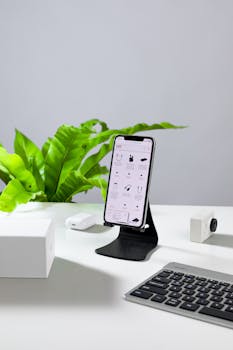
In practice, the reason you keep checking your device has less to do with willpower and more to do with architecture. Software engineers design mobile applications using variable reward schedules, a psychological technique where users receive unpredictable positive feedback to build addiction. As a result, your brain anticipates a social or informational reward every time you see a badge icon or hear a chime. Understanding this mechanism allows you to detach your sense of self-worth from your digital engagement. Furthermore, recognize that your phone is not inherently “bad,” but it is an engine designed to capture your time. A common mistake here is believing that you can simply “resist” the urge through sheer discipline. Instead, you must manipulate your environment to make the distraction difficult to access, thereby lowering the probability of the behavior occurring. Key takeaway: Acknowledge that your phone is designed to distract you, then design your environment to remove that friction.
The impact of notification fatigue
Notification fatigue occurs when your brain becomes overwhelmed by the sheer volume of alerts, causing you to check your phone as a defensive mechanism. You check to “clear” the clutter, but you inevitably find new information that keeps you engaged. This cycle is a major drain on Productivity. To break this, you should audit your alerts immediately.
| Notification Type | Keep or Delete | Rationale |
|---|---|---|
| Social Media Likes | Delete | Irrelevant to daily output |
| Work Communication | Keep (Filter) | Essential for operational flow |
| News Updates | Delete | Distracts from primary goals |
| Calendar Alerts | Keep | Maintains temporal awareness |
Implementing digital friction to regain focus
Digital friction involves creating physical or software-based barriers that force you to pause before using your phone. When you make it harder to access social media or email, you give your prefrontal cortex, the part of the brain responsible for logical decision-making, a chance to override the impulsive urge to check your device. From experience, I have found that placing my phone in a separate room during deep work sessions is the single most effective intervention. If the phone is in your pocket, the cost of distraction is zero. When it is in a drawer in another room, the cost of distraction involves standing up and walking, which is often enough to stop the impulse. Furthermore, consider turning your display to grayscale. By removing the vibrant colors that signal reward to your brain, the interface becomes significantly less appealing and less addictive over time. Key takeaway: If you create physical or visual barriers, you significantly reduce the impulse to check your phone.
Using software tools to automate boundaries
You can use built-in tools like “Screen Time” on iOS or “Digital Wellbeing” on Android to enforce strict limits. However, do not just set a timer; automate the process so you do not have to make the decision every day. If you struggle with specific apps, use a blocker that prevents access entirely during work hours.
For those who need a programmatic approach, you can use a simple script to log your app usage and audit your own behavior. This adds a layer of objective data to your subjective experience.
// Simple example of tracking focus time
const sessionStart = Date.now();
const focusDuration = 3600000; // 1 hour in milliseconds

function checkFocusStatus() {
  const elapsed = Date.now() - sessionStart;
  if (elapsed < focusDuration) {
    console.log("Stay focused. Distraction is currently blocked.");
  } else {
    console.log("Session complete. Take a break.");
  }
}
checkFocusStatus();
Structuring your day to manage dopamine
When you structure your day, you must account for your natural energy rhythms. Many people fall into the trap of checking their phones first thing in the morning, which floods the brain with cortisol and dopamine. This state of “reactive” living makes it difficult to engage in “proactive” work later in the day. A helpful approach is the “no-phone” morning rule. Dedicate the first 60 minutes of your day to your most important task, or “MIT,” without touching your device. Furthermore, if you are working on high-value projects, treat your phone as a piece of equipment that is “off-duty.” A common mistake is keeping your phone on your desk while working; even a silent phone acts as a cognitive load because your brain is subconsciously tracking its presence. Always place it face down or, better yet, out of sight. Key takeaway: Protect your morning focus by enforcing a strict “no-phone” rule for the first hour of your workday.
Batching your communications
Instead of responding to every message instantly, you should batch your communication. This means checking your messages at set intervals, such as 10:00 AM, 1:00 PM, and 4:30 PM. This method prevents the constant state of “context switching,” which is the process of jumping between unrelated tasks, and ensures you remain in a state of flow.
- Define three specific times in your day for email and messaging checks.
- Notify your team or stakeholders that you are practicing deep work intervals.
- Use an auto-responder or status update to manage expectations.
- Stick to the schedule strictly to build trust with your own goals.
- Evaluate your progress weekly to see how much more you accomplished.
Reframing your relationship with mobile tech
The final step involves a mindset shift toward intentionality. You are not a passive victim of technology, but an active user of tools. If you use your phone for work-related communication, such as using AI tools for research or organization, ensure the device is configured for production, not consumption. This often means removing all non-essential apps that provide no utility. From experience, deleting apps like Twitter or Instagram from your main device is the best way to handle this. If you must use them, use the web browser version. The browser interface is generally clunky and lacks push notifications, which provides a natural deterrent. Furthermore, realize that the goal is not to eliminate your phone, but to reclaim your attention. Acknowledge that this process is non-linear; some days you will succeed, and some days you will fail. The key is to iterate on your process. Key takeaway: Use your phone as a specialized tool for work and remove any apps that primarily serve as a source of mindless consumption.
Building a sustainable digital environment
If you find yourself sliding back into old habits, revisit your environment setup. Sometimes a simple update in your phone’s “Focus” mode settings can be the reset you need. You can create a custom script or automation to help manage your environment as well.
// Automating a "Do Not Disturb" reminder
const isWorkHours = true;
const phoneDistractionLevel = "High";

if (isWorkHours && phoneDistractionLevel === "High") {
  console.log("Activating deep work mode and silencing alerts.");
  // Add your logic here to trigger system DND
}
In conclusion, overcoming the feeling of being constantly distracted by your phone requires a combination of environmental design and habit formation. You have learned that your phone is designed to disrupt your focus, but you now have the tools to counter those design choices. By setting up physical barriers, batching your communications, and removing addictive apps, you shift from being a passive consumer to an intentional operator. Remember that this is a continuous process of calibration. It is perfectly normal to struggle initially as you rewire your brain away from instant gratification loops. Start small by leaving your phone in another room for just one hour today. As you build confidence with this small win, extend the duration until you regain command over your own attention. Your time is your most valuable asset, so treat it with the discipline it deserves.
Cover image by: I’m Zion / Pexels